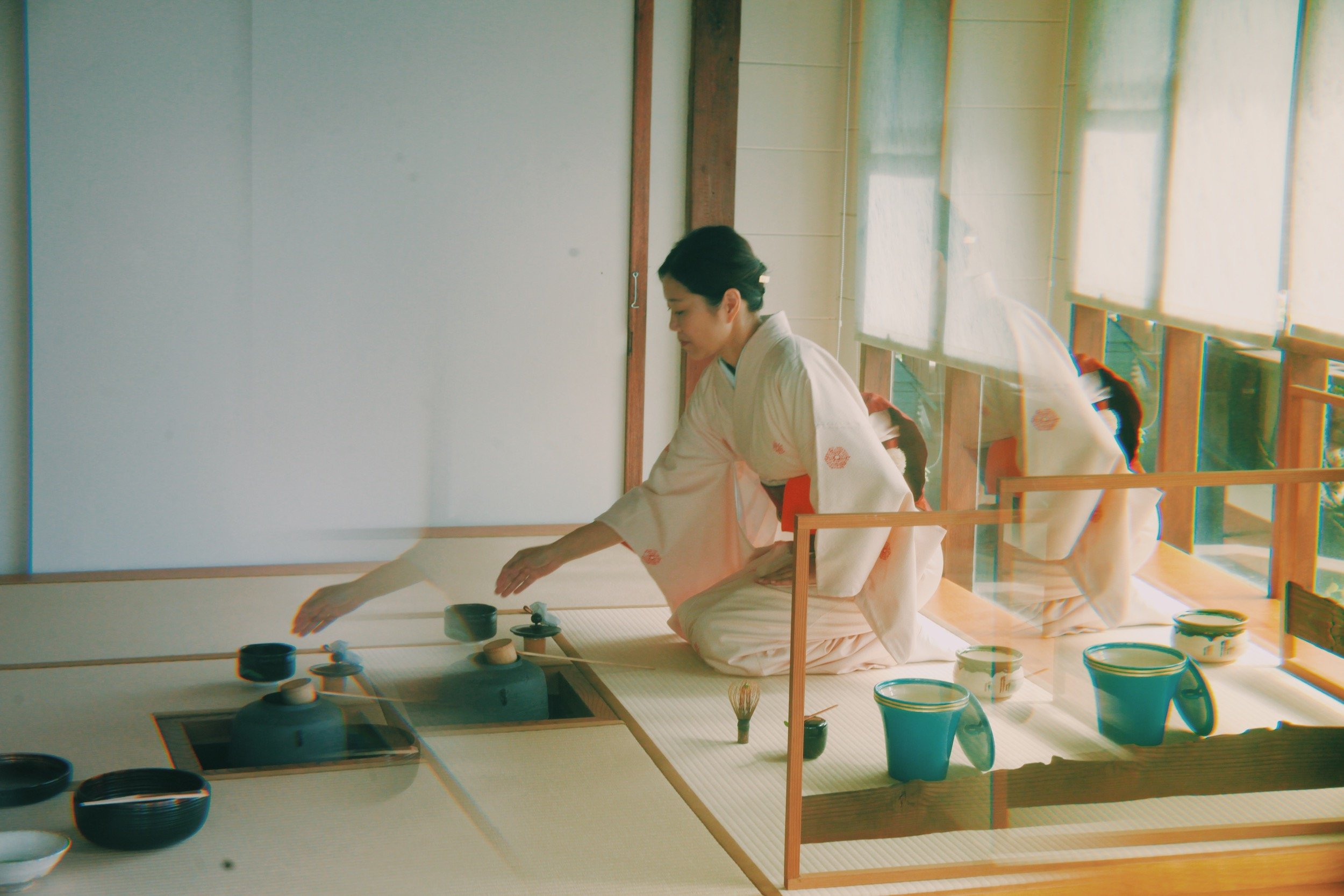
Exploring the Chabako
I believe the essence of Chanoyu lies in the shared enjoyment of time between host and guest, and in cultivating an appreciation for the beauty found in everyday life. Tea is not strictly confined to the tearoom; since ancient times, it has been practiced outdoors and in diverse settings. While I honor the rigorous and dedicated training that forms the foundation of my practice, I find the Chabako (portable tea box) to be a perfect medium for embracing asobi-gokoro—a playful, creative spirit.
Until the year before last, I maintained a tea room in Taipei. Currently, while continuing my training in Tokyo, I occasionally enjoy tea using my Chabako. In the past year, I have been blessed with many unforgettable experiences: visiting a friend in Europe to celebrate our reunion over a bowl of tea; finding tranquility amidst the grand scenery of the Suginohara Highlands in Niigata at an altitude of 1,800 meters; admiring the autumn leaves in a Tokyo garden; and even having the humbling honor of serving tea to a monk at a Zen temple. In a world filled with novelties and constant stimulation, I have come to realize that intentionally making time for host and guest to face one another over tea is, in fact, a time to face one’s true self. It would be my greatest pleasure to share with you a bowl of tea that is at once authentic and informal—a moment of serenity woven into the fabric of daily life.
A Chabako is a small wooden box designed to hold a minimal set of portable tea utensils. Throughout history, Chanoyu has never been confined solely to the tearoom. The Chabako allows one to easily carry the necessary tools to the outdoors or on a journey, making it possible to whisk tea and share a joyful moment anywhere, at any time.There are no rigid rules governing which tools should be included in a Chabako. One might choose a bowl found during travels, a gift from a dear friend, or a favorite daily object, paired with a suitable tea container. This freedom of kufu (creative arrangement and ingenuity) allows for a casual yet deeply personal bowl of tea—one of the true joys of the tea path. Within the Omotesenke school, there are no specific, fixed regulations for the Chabako procedures (temae), allowing for a flexible and imaginative approach.
Photo Credit: Manbo Key